


You don't have to give up your morning coffee to keep a brighter smile.
You don't have to give up coffee to have whiter teeth. Professional teeth whitening lifts existing coffee stains, and a few changes to how you drink your coffee help the new shade last much longer.
Coffee is one of the most common reasons people ask us about teeth whitening in Manchester, and one of the most common reasons results fade sooner than expected. The good news is that coffee staining usually responds well to treatment. What makes the difference is what you do afterwards.
Why coffee stains teeth
Coffee contains strongly coloured compounds, including tannins, that stick to the thin protein layer on the surface of your teeth. Enamel looks smooth but is slightly porous, so over time those pigments build up into surface stains and a gradual yellowing of the overall shade.
Coffee is also mildly acidic. How often your teeth meet it matters more than how much you drink, because every cup sets the stain-and-acid cycle going again.
Black coffee or with milk?
Black coffee delivers the most pigment straight to your teeth. Adding milk may help a little, as some research suggests milk proteins bind to some of the staining compounds, but it won't stop staining on its own.
Watch what else goes in. Sugar and flavoured syrups add a decay risk, and a sweetened latte sipped through the morning is harder on your teeth than a black coffee drunk in one go. Iced coffee through a straw keeps more of it off your front teeth.
Rinse with water after every cup
Swish a mouthful of water around your mouth after each coffee. It washes pigment off before it settles and helps bring the acid level down. A glass of water alongside your coffee does the same job, and so does chewing sugar-free gum, which gets saliva flowing.
Brush after your morning coffee, not before
If you brush first thing and then have your coffee, it sits on your teeth for the rest of the morning. Brushing after your coffee clears it away. Wait 30 to 60 minutes first, though. Coffee is acidic, and brushing straight after an acidic drink can wear enamel while it's softened. If you're short of time, rinse with water straight away and brush once you get to work.
Drink it, don't sip it all day
A coffee finished in 15 minutes stains less than the same cup nursed for two hours. If you like a drink at your desk, alternate coffee with water so your teeth get a break.
How teeth whitening in Manchester works for coffee drinkers
Treatment starts with a check of your teeth and gums, because whitening should only go ahead when your mouth is healthy. We then take scans to make custom trays that fit your teeth closely. In the UK, professional whitening gels can only be provided by a registered dental professional.
With Boutique at-home whitening, from £320, you wear the trays with a professional-strength gel and the shade improves over a couple of weeks. Many patients are happy within two to three weeks. Enlighten whitening, from £590, combines an in-surgery session with at-home whitening. Whitening won't change the colour of existing fillings, crowns or veneers, so we check for those before you start. If you're wondering how far your shade can go, our article on how many shades whiter your teeth can get explains what's realistic.
Coffee during whitening
Teeth pick up colour more easily while you're actively whitening. Your clinician will tell you what to avoid, and most coffee drinkers find it easiest to skip coffee for a while after each session with the trays, or switch to a lighter option until the course is finished. Some people notice temporary sensitivity, which usually settles.
Keeping your new shade
One advantage of tray-based whitening is that you keep your trays. When your shade starts to dull, a short top-up with gel, which you can buy from reception, is usually enough. Results commonly last six months to two years before a touch-up, and coffee drinkers tend to be at the shorter end.
Regular stain removal at a hygiene visit clears the surface staining that brushing can't shift. Our hygienists, Teresa Hollins and Ramah Isameldin, can keep your teeth clean and your results looking fresh between check-ups. If your teeth were yellowing before you started drinking much coffee, our article on why teeth can look yellow even when you brush every day covers the other causes.
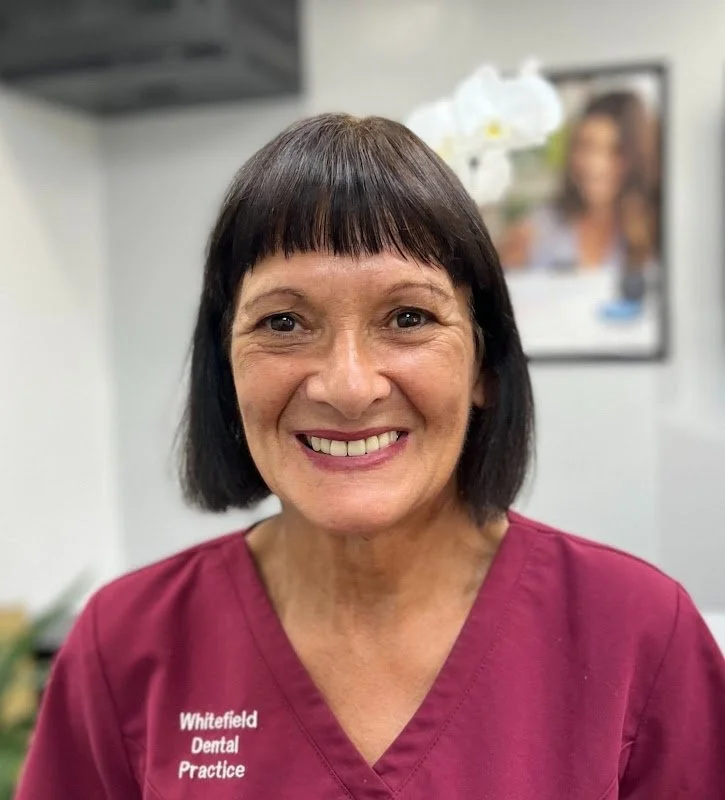
Teresa Hollins, Dental Hygienist at Whitefield Dental.
Book teeth whitening in Manchester
We're on Radcliffe New Road in Whitefield, and our late Tuesday appointments suit people who commute into Manchester. If coffee has dulled your smile, a consultation for teeth whitening in Manchester is the simplest way to find out how much brighter your teeth could be and how to keep them that way.
Whitefield Dental is at 118 Radcliffe New Road, Whitefield, Manchester M45 7WQ. Call us on 0161 524 9883 or email dentist@whitefielddentalpractice.co.uk. We're open Monday, Wednesday and Thursday 9am to 6pm, Tuesday 9am to 8pm, Friday 8am to 3pm and Saturday 9am to 1pm by pre-booking. You can spread the cost of treatment with 0% Tabeo Finance or Snap Finance.
Frequently asked questions
Do I have to stop drinking coffee after teeth whitening?
No. Cutting back during treatment helps, but afterwards rinsing with water after each cup and regular hygiene visits do most of the work.
Does adding milk to coffee reduce staining?
It may help a little, but it won't stop staining on its own. Rinsing with water and drinking your coffee in one go make more difference.
Should I brush before or after my morning coffee?
After, but wait 30 to 60 minutes. Brushing straight after an acidic drink can wear softened enamel, so rinse with water first.
How long does whitening last for coffee drinkers?
Professional whitening commonly lasts six months to two years. Coffee drinkers usually need top-ups sooner, which your custom trays make easy.
